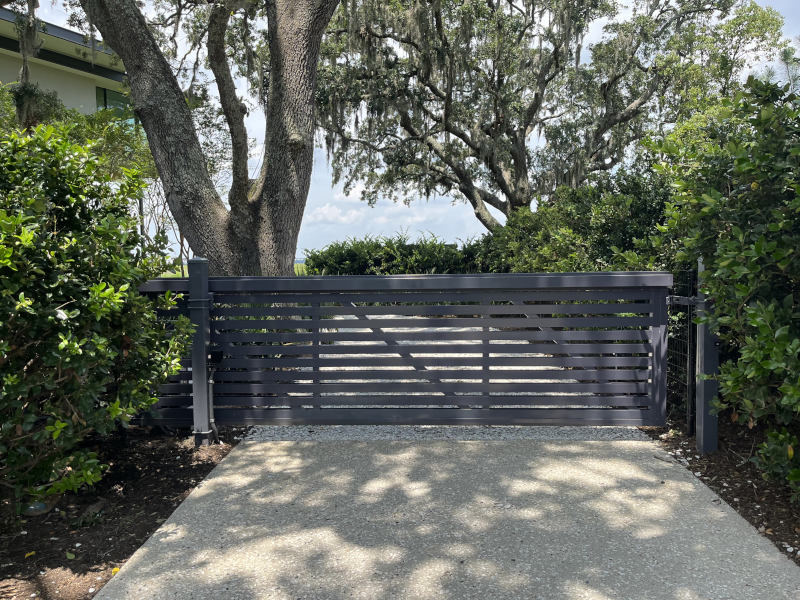
Modern gates improve home convenience through smartphone-based remote access, rolling code wireless entry systems, integration with smart home platforms, video intercom connectivity, automated vehicle detection, scheduled access control, and battery backup that keeps the gate operational during power outages. The biggest shift in residential gate technology over the past decade is not mechanical but behavioral: homeowners no longer manage a gate by physically operating it but by managing access permissions, monitoring entry logs, and responding to visitor alerts from anywhere with a phone signal.
Overhead Door Company of Charleston installs and services modern gate systems throughout Charleston and nearby communities.
From Manual to Modern: What Changed in Gate Technology
The transition from a manual swing gate with a padlock to a modern automated system represents a fundamental change in how homeowners think about property access. Manual gates required physical presence to operate. Modern gate operators respond to encrypted wireless signals, smartphone commands, and sensor inputs without the homeowner needing to be near the gate.
Modern residential gate operators are classified by DASMA duty cycle ratings, with today’s residential systems typically rated for 200 to 300 cycles per day, a volume that would have required commercial-grade hardware two decades ago. Technicians installing residential gate systems regularly encounter properties still relying on manual gates or outdated fixed code operators. The most common reason homeowners delay upgrading is not cost but unfamiliarity with what modern systems can do. Once the system is commissioned and the homeowner walks through the app, the hesitation disappears.
Smartphone and Remote Access Control
Modern gates allow homeowners to open, close, and monitor their gate from a smartphone regardless of location. Dedicated gate apps pair with the operator’s Wi-Fi or cellular module, giving the homeowner real-time gate status, an activation history log, and the ability to trigger the gate remotely.
The communication between a smartphone app and a gate operator uses encrypted API calls over TLS, which stands for Transport Layer Security, the same encryption protocol used in online banking. This means the gate’s access channel relies on the same foundational encryption standard as a financial transaction rather than the open radio frequency that older fixed-code systems used, which were vulnerable to replay attacks. Remote access eliminates the need to be home to accept deliveries, let in contractors, or grant access to family members.
Rolling Code Technology and Entry Security
Rolling code technology in modern gate remotes and keypads improves both security and convenience. Every button press generates a mathematically unique encrypted code valid for one use only, making code-grabbing attacks that worked against fixed-code systems completely ineffective.
Rolling code systems use a synchronized algorithm between transmitter and receiver based on a pseudo-random number sequence. The receiver only accepts the next valid code in the sequence and discards any previously used or out-of-sequence transmission. The receiver cannot be fooled by replaying a captured signal because that signal is already mathematically expired. Handing a remote to a contractor carries no long-term security risk. The code changes with every press, so there is nothing to copy or misuse after the job is done.
Video Intercom and Visitor Management
Video intercom systems integrated with modern gate operators allow homeowners to see, speak with, and grant or deny access to visitors without leaving the house or being home. Modern gate intercoms connect to the homeowner’s smartphone through the same app that controls the gate, so a visitor pressing the intercom button triggers a live video and audio connection on the homeowner’s phone.
Technicians installing gate intercom systems consistently find that homeowners with young children, elderly residents, or home-based workers report the biggest quality of life improvement from intercom integration. These households have the most frequent gate interactions, and the intercom converts each from a physical trip to a thirty-second phone-based decision. The homeowner sees the visitor, speaks through the intercom, and opens the gate with a button press without leaving their desk or their child’s side.
Automated Vehicle Detection
Loop detectors and infrared sensors allow modern gates to detect approaching vehicles and open automatically without requiring a remote press or code entry. Inductive loop detectors are embedded in the driveway surface and detect the electromagnetic field disruption caused by a vehicle’s metal mass passing over the loop.
Loop detectors in residential gate systems are calibrated to detect vehicles above a minimum mass threshold, typically set to exclude bicycles, pedestrians, and small animals while reliably triggering for cars, trucks, and SUVs. This calibration prevents false activations that add wear to the operator mechanism. Exit loop detectors prevent the gate from closing on a vehicle still in the opening, eliminating damage and safety risks that older systems without exit detection created regularly. Proper calibration of both entry and exit detectors directly affects daily convenience and gate lifespan.
Scheduled and Time-Based Access Control
Modern gate operators allow homeowners to program scheduled access windows that automatically manage the gate at defined times. Time-based access control is useful for households with regular service providers such as landscapers, housekeepers, or childcare workers who arrive at predictable times each week.
Homeowners who set up scheduled access consistently report the biggest convenience gain is eliminating the back and forth of providing temporary codes or being present to let vendors in. This feature is one of the most underused on systems that support it because homeowners are often not walked through it during installation. Access windows can be set by day of the week, time of day, and specific credential, so the landscaping crew can enter on Tuesday and Thursday mornings and the gate will not respond to their credential at any other time.
Guest and Temporary Access Codes
Modern gate systems support temporary access codes that can be created, shared, and expired without affecting permanent user credentials. Temporary codes are generated through the gate’s access control app and can be set to expire after a single use, a defined number of uses, or at a specific date and time.
Technicians commissioning new gate systems regularly find that the temporary code feature is underused because homeowners were not walked through its setup during installation. Temporary codes solve real friction points for homeowners managing short-term rentals, guests, or renovation projects where multiple contractors need access across different days. A temporary code expiring at the end of a renovation project eliminates the need to change the permanent code afterward, a step most homeowners forget until they realize the contractor still has access weeks later.
Battery Backup and Power Outage Operation
Battery backup systems in modern gate operators keep the gate functional during power outages, which is especially important in coastal areas like Charleston where severe weather can disrupt power for extended periods. Properly maintained residential backup batteries are typically rated to support 50 to 100 activation cycles before requiring a recharge, though actual capacity varies with battery age and ambient temperature, factors that matter in coastal and high-humidity environments.
In areas that experience frequent storm-related outages, technicians servicing gate systems after weather events consistently find that homes without battery backup face a practical access problem: the gate is locked in whatever position it was in when power failed. A gate open when the storm hit stays open through the event, leaving the property unsecured. A gate that was closed traps vehicles inside or locks residents out until power returns. Battery backup removes this vulnerability by allowing the gate to operate through the outage on stored charge.
Integration With Smart Home Systems
Modern gate operators integrate with smart home platforms including voice assistants, home automation hubs, and security systems. Gate operators with Wi-Fi or Z-Wave connectivity can be added to smart home ecosystems for voice control, automated routines, and connection to exterior lights that activate when the gate opens after dark.
Gate operators that support IFTTT, which stands for If This Then That, allow homeowners to create custom automation rules without programming knowledge. Examples include turning on driveway lights when the gate opens after sunset, sending a push notification when the gate has been open for more than five minutes, or locking the gate at a defined time each night. These automations run without manual input once configured, transforming the gate from a device the homeowner operates into one that operates on their behalf.
Professional Installation and Long-Term Reliability
The convenience features of a modern gate depend on correct initial programming, sensor calibration, and network configuration. A gate system installed without that attention delivers a fraction of its intended convenience because the features that matter most do not function correctly when the underlying setup is incomplete.
A gate system installed correctly from day one, with properly calibrated loop detectors, aligned photo eye sensors meeting UL 325 entrapment protection requirements, access control components complying with ANSI/UL 294, the standard governing access control system units, and a fully commissioned access control system, delivers the daily convenience it was designed for. A system commissioned without that care requires repeated service calls for issues that should have been resolved before the technician left the job site, consuming the time savings the system was installed to create.
Schedule Your Gate Installation With Overhead Door Company of Charleston
If you are considering a modern gate system for your property, Overhead Door Company of Charleston is ready to help. Ranked among the top residential dealers at the 2025 IDA national convention, our team installs and services gate systems throughout Charleston and nearby communities, from site assessment through access control programming, video intercom setup, and ongoing maintenance. Reach out to Overhead Door Company of Charleston today to schedule a professional gate assessment.