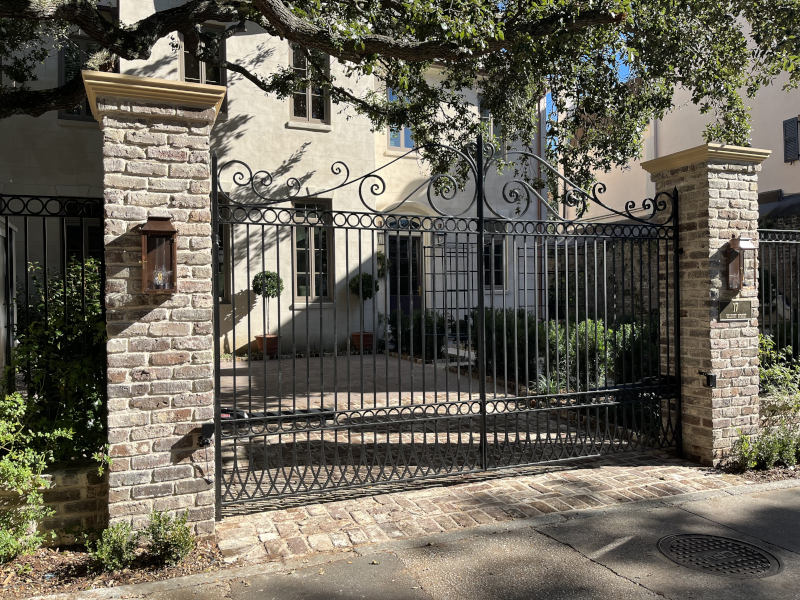
Most gate failures do not arrive without warning. The signs appear weeks or months before a full breakdown, and homeowners who recognize them early avoid the more disruptive consequence of a gate that fails during a weather event or when a contractor is on site. The signs you need gate service include slow or hesitant movement, grinding or scraping sounds, inconsistent remote response, visible rust or corrosion on hardware, a gate that reverses before fully closing, blinking sensor indicator lights, gate sag or ground contact, operator performance that declines in heat, and delayed access control response.
Overhead Door Company of Charleston provides gate service throughout Charleston and nearby communities.
Slow or Hesitant Gate Movement
A gate that takes noticeably longer to complete its travel than when new, or that pauses mid-travel before continuing, is showing early signs of operator strain, spring fatigue, or mechanical drag. Many homeowners adapt to the slower pace without recognizing it as a warning sign.
Technicians diagnosing slow gate movement regularly find that the root cause is not the operator motor but dry or corroded hinges that have increased mechanical resistance. A hinge running dry can increase resistance to the point where the operator works significantly harder than designed, shortening motor service life with every cycle. Lubrication and hardware inspection resolves slow movement in the majority of cases without motor replacement.
Unusual Sounds During Operation
Grinding, scraping, clicking, and popping during gate operation each point to a specific mechanical problem. Grinding suggests metal-on-metal contact where lubrication has failed. Scraping suggests the gate panel is contacting the ground, a post, or a frame element it should clear. Clicking indicates a hinge pin worn enough to allow lateral movement rather than pure rotation.
Hinge pins on swing gates are rated for a defined number of cycles and a specific load tolerance. When the pin wears to the point where lateral play develops, the clicking signals the hinge has reached the end of its rated service life. Continuing to operate on a worn hinge pin places load on the hinge body, accelerating bracket failure. Addressing the clicking when it first appears is significantly less expensive than addressing it after the bracket has failed.
Inconsistent Response to Remote or Keypad
A gate that responds on some presses but not others, or requires the remote to be held unusually close to trigger a response, is showing signs of antenna degradation, receiver wear, or battery depletion.
Replacing the remote battery resolves the issue in roughly half of intermittent response cases. The other half typically involve a damaged antenna wire or a receiver board with sensitivity loss from age or moisture. A less obvious cause is proximity to LED bulbs that emit radio frequency interference on the same band as the gate remote, typically 315 MHz or 390 MHz for most residential systems. Identifying and removing that interference source restores receiver sensitivity without replacing hardware.
Visible Rust, Corrosion, or Hardware Damage
Surface rust on a gate hinge is a cosmetic issue. Rust that has penetrated the hinge pin or bracket is a structural concern because corroded steel loses tensile strength in ways not visible from the surface. ASTM A370, the standard test method for mechanical testing of steel products published by ASTM International, provides the framework for understanding how corrosion degrades tensile and yields strength in structural steel components.
Gate hardware in coastal environments like Charleston can reach critical corrosion levels significantly faster than the manufacturer’s rated service life assumes. A hinge bracket that looks intact may have lost measurable load capacity due to subsurface corrosion visible only after failure. Annual inspection in coastal gate installations is a functional safety requirement. A technician can identify corrosion past the cosmetic stage before it becomes a structural failure.
Gate Reverses Before Fully Closing
A gate that reverses before completing its closing cycle is responding to one of two triggers: a photo eye sensor beam interruption or a pressure reversal threshold reached before the gate contacts the stop.
Technicians responding to reversal complaints regularly find that spider webs across the photo eye beam path are the cause in a surprising number of cases, particularly in gates not serviced recently. The fine strands of a web are dense enough to interrupt the infrared beam without being visible from a casual inspection distance. Clearing the beam path and cleaning the sensor lenses resolves the reversal in these cases. UL 325, the standard governing automatic gate operator safety systems, requires that the pressure reversal system be tested during every service visit to confirm the gate reverses within the standard’s defined response threshold.
Blinking or Misaligned Sensor Indicator Lights
A steady indicator light on both photo eye sensors means the beam path is clear and alignment is correct. A blinking light means misalignment, an obstruction, or damage to the sensor lens or wiring. The gate will not close with a blinking sensor.
Photo eye sensors operate on an infrared beam narrow enough that misalignment of as little as a few degrees breaks the signal entirely. Technicians aligning gate sensors after a service call commonly find that the sensor bracket has been shifted by a vehicle, a lawn mower, or a weed trimmer that came too close to the post. The bracket moves only slightly but the beam geometry changes enough to cause an intermittent or constant beam break. Verifying the steady indicator light on both sensors confirms correct alignment before returning the gate to service.
Gate Sag or Ground Contact
A swing gate that sags at the free end is showing signs of hinge wear, post movement, or hardware loosening that drops the panel below its designed travel path. A gate dragging along the ground needs immediate service because continued operation accelerates damage to the panel, post, and operator.
Technicians servicing sagging swing gates in coastal areas commonly find the cause is post movement rather than hinge wear. In sandy or loose soil common in the Charleston area, a concrete footing that has shifted even slightly tilts the post and alters the gate’s plane of travel. Increasing the operator’s force settings to push through the drag is counterproductive and accelerates failure in the operator, hinges, and post hardware simultaneously.
Operator Performance That Declines in Heat
A gate operator that slows down or struggles during hot weather is showing signs of thermal stress. Electric motors operating near their rated duty cycle produce more heat under load, and high ambient temperatures reduce the motor’s ability to dissipate that heat, lowering the point at which thermal protection activates.
Electric motors are rated with a service factor defining how much above rated load they can operate without damage. A motor near its service factor limit in high ambient temperatures has measurably shorter winding life than the same motor within its comfortable load range. In coastal South Carolina, summer temperatures in direct sun can push a gate operator above its tested and rated range. A gate fine in spring and struggling in August is running an undersized operator for the gate’s weight and cycle demands.
Delayed or Failed Access Control Response
A keypad, intercom, or card reader that responds slowly, intermittently, or not at all is a gate service issue even when the gate appears functional. Access control components are vulnerable to moisture ingress, terminal corrosion, and firmware issues.
Technicians servicing access control failures regularly find that the root cause is corroded wiring at the keypad terminal block rather than a failed keypad. Salt air and humidity accelerate corrosion on exposed terminals, and a connection acceptable on a voltage check may still have enough resistance to create intermittent signal failures under operating conditions. Cleaning and re-terminating corroded connections restores full function without replacing hardware. ANSI/UL 294, the standard governing access control system units, defines performance requirements technicians use to determine whether a component has failed to specification or is experiencing an environmental issue correctable without replacement.
When to Schedule Gate Service
Any single sign from the sections above is sufficient reason to schedule a professional inspection rather than waiting. In most cases, the underlying mechanical causes of gate problems do not resolve without intervention and the direction is almost always toward greater damage and higher repair cost.
Gate systems in coastal environments like Charleston, where salt air accelerates hardware corrosion and humidity affects access control components, benefit from professional inspection at least once per year even without visible symptoms. A gate service visit that finds no urgent issues is not wasted time. It produces a documented inspection record, confirms that safety reversal systems meet UL 325 response thresholds, and identifies hardware approaching end of service life before it fails during a storm.
Schedule Gate Service With Overhead Door Company of Charleston
If your gate is showing any of the signs described above, Overhead Door Company of Charleston is ready to help. Ranked among the top residential and commercial dealers at the 2025 IDA national convention, our team provides gate service including hardware inspection, sensor alignment, access control diagnostics, UL 325 safety reversal testing, and operator evaluation throughout Charleston and nearby communities. Reach out today to schedule a gate service visit before a warning sign becomes a failure.