Commercial door operators are essential across warehousing and distribution, manufacturing, food processing, cold storage, healthcare, automotive service, fire and emergency services, self-storage, and retail loading operations. They are not interchangeable because each industry places different demands on the operator in terms of cycle volume, environmental exposure, safety requirements, and access control integration. The wrong operator in the wrong application fails early and costs more in repairs than a correctly specified installation would have.
Overhead Door Company of Charleston specifies, installs, and services commercial door operators across industries throughout Charleston and nearby communities.
What Makes a Commercial Door Operator Different
A commercial door operator is not a scaled-up residential garage door opener. The two differ in motor class, duty cycle rating, torque output, enclosure construction, and access control capability. Residential openers are designed for light use at four to eight cycles per day and are not rated for continuous operation.
Commercial operators are classified by duty cycle ratings from standard duty at up to 25 cycles per day through heavy duty and continuous duty ratings for facilities cycling hundreds of times per shift. DASMA, the Door and Access Systems Manufacturers Association, provides operator classification frameworks defining the relationship between duty rating, motor class, and application requirements. Matching the operator’s duty rating to the facility’s daily cycle count is the most important specification decision in a commercial installation. Getting it wrong produces a motor that degrades faster than the warranty predicts and fails at the moment replacement is most disruptive.
Warehousing and Distribution Centers
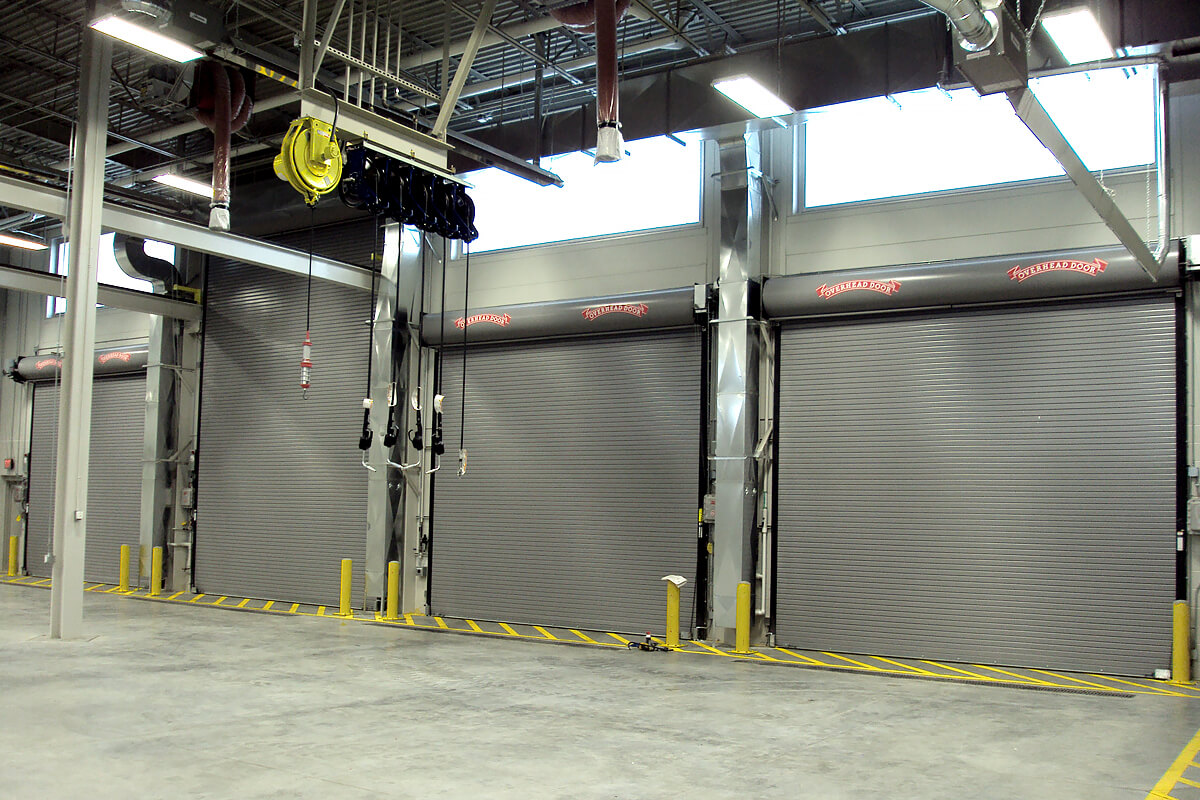
Warehousing and distribution facilities depend on commercial door operators at loading docks, bay doors, and freight access points that cycle constantly throughout every shift. High-bay doors in distribution centers can weigh several hundred pounds, requiring operators with sufficient torque ratings to handle that load across thousands of daily cycles without thermal shutdown.
Facilities that specified standard duty operators on high-volume bays typically see motor failures within two to three years, long before the door hardware shows wear. The motor fails not because anything is broken but because it was never designed to run at that duty level. Loop detectors embedded in the dock approach automate door activation for forklift traffic without a separate control command, reducing cycle time and keeping freight flow uninterrupted during peak operations.
Manufacturing and Industrial Plants
Manufacturing environments use commercial door operators at production floor access points, equipment bays, and utility entrances where doors move frequently but face exposure to dust, heat, vibration, and chemical vapor that degrades standard components over time.
Operators in manufacturing environments must be rated for the facility’s ambient temperature range. Motor windings in operators not rated for elevated temperature develop insulation breakdown that leads to failure at temperatures a properly specified operator handles without issue. The motor appears functional during cooler periods and fails only when the plant reaches operating temperature, making the root cause difficult to recognize without knowing the installation specification. Industrial operators are often wired to production line safety systems so the door cannot activate while equipment is running, creating an interlock that prevents doors from cycling into active machinery.
Food Processing and Cold Storage Facilities
Food processing and cold storage environments place the most demanding combination of requirements on commercial door operators. Cold storage facilities require operators rated for sustained low temperatures. Food processing environments require wash-down rated enclosures to protect motor and control components from high-pressure cleaning with hot water and chemical sanitizers. When both requirements apply to the same facility, standard commercial operators are almost never the right choice.
In cold storage environments where the operator enclosure is not rated for the facility’s temperature range, condensation forms inside the control board housing during temperature transitions between the loading dock and the cold room. That moisture damages the logic board in ways that appear as intermittent faults rather than clear failures. A facility experiencing repeated unexplained operator faults and replacing the control board multiple times is almost always dealing with moisture ingress from an undersized enclosure rating, not a defective board.
Healthcare Facilities and Hospitals
Hospitals and healthcare campuses use commercial door operators at service entrances, loading docks, emergency vehicle access points, and utility areas. Operators must meet standards around noise level, access control integration with badge systems, and reliability, because a failed operator at a hospital loading dock can interrupt pharmaceutical and supply deliveries with direct patient care implications.
Technicians servicing commercial operators at healthcare facilities consistently find that low-noise belt drive or direct drive operators are specified over chain drive models for areas adjacent to patient care zones. The acoustic impact of a chain drive operator on a heavy door traveling through a wall shared with a patient corridor is significant enough to disturb nearby patients. In post-surgical recovery and intensive care units, noise disruption is associated with measurable effects on patient recovery and outcomes, a finding consistent with peer-reviewed healthcare facility acoustic research, making operator specification part of the facility’s acoustic management plan.
Automotive Dealerships and Service Centers
Automotive service facilities use commercial door operators across multi-bay service floors where doors cycle frequently throughout the business day. Operators face exposure to oil mist, exhaust fumes, and temperature changes that accelerate wear on standard components faster than the same operator in a climate-controlled setting.
Overhead Door Company of Charleston technicians servicing operators at auto service environments have found that hardware components including rollers, hinges, and drive systems show faster wear than the same parts in other commercial applications. An operator that runs two years between service intervals in a clean commercial environment may need inspection every six to nine months in an active auto service bay to prevent accelerated wear from reaching the point of failure.
Fire Stations and Emergency Response Facilities
Fire stations represent one of the most demanding commercial door operator applications because of high cycle volume, surge demand during emergency activations, and the life-safety consequence of failure at the wrong moment. When an apparatus bay door fails to open during an emergency response, the result is a delayed response with direct public safety consequences.
Fire station apparatus bay operators are specified with battery backup systems that allow the door to complete its opening cycle during a power outage, because power disruptions and emergency activations can coincide. All automatic door operators in these applications must meet UL 325, the standard governing automatic operator safety systems including entrapment protection zones, required safety devices, and emergency operation protocols. An operator meeting UL 325 with battery backup addresses both the life-safety compliance and emergency operational requirement in a single specification.
Self-Storage Facilities
Self-storage facilities use commercial door operators differently from every other industry. The operator serves individual unit doors accessed by tenants rather than staff, meaning it must function reliably without facility intervention and operate simply enough for a non-technical user.
Facilities integrate commercial door operators with perimeter gate systems and keypad entry so a tenant’s access code activates both the gate and the unit operator through a single credential. In facilities that converted from mechanical roll-up doors to automated operators, the most common post-installation service call involves photo eye sensor alignment caused by tenants storing items too close to the door opening, interrupting the beam and preventing closure. A brief orientation at move-in about sensor clearance requirements reduces these calls significantly.
Retail and Commercial Loading Docks
Retail distribution centers and commercial loading docks use commercial door operators at receiving and shipping bays where the door is one component in a larger dock safety system. The operator must be compatible with dock leveler systems and vehicle restraints so the sequencing between door position, leveler deployment, and vehicle restraint engagement happens in a defined order.
Loading dock operators integrate with dock safety interlock systems governed by OSHA 29 CFR 1910.178, covering powered industrial truck operations near loading dock areas. The door cannot lower until the leveler is retracted and the restraint disengaged, and the restraint cannot release until the driver receives a visual signal clearance. Facilities that bypass this interlock create an OSHA compliance gap and expose dock workers to crush injuries the interlock was specifically designed to prevent. In facilities where the interlock has been disabled to speed throughput, the consequence is not always an immediate incident but a near-miss pattern that escalates until it becomes one.
Choosing the Right Commercial Door Operator for Your Industry
Selecting a commercial door operator by price alone without matching duty cycle rating, motor class, and enclosure specification to the environment is one of the most common reasons facilities experience early operator failure. The cost of replacement, labor, and downtime almost always exceeds what a correctly specified operator would have cost at installation.
The key specification variables are duty cycle rating matched to daily cycle count, motor torque matched to door weight, ambient temperature rating, enclosure rating for moisture and chemical exposure, access control compatibility on systems with integrated credential management, battery backup for emergency applications, and UL 325 compliance. Working with a provider who understands how these variables interact ensures the operator installed on day one is still performing on schedule years later.
Schedule a Commercial Door Operator Assessment With Overhead Door Company of Charleston
If your facility’s commercial door operators need to be evaluated, upgraded, or serviced, Overhead Door Company of Charleston is ready to assist. Ranked among the top commercial dealers at the 2025 IDA national convention, our team specifies, installs, and maintains commercial door operators across industries throughout Charleston and nearby communities. Reach out to Overhead Door Company of Charleston today to schedule a professional operator assessment.