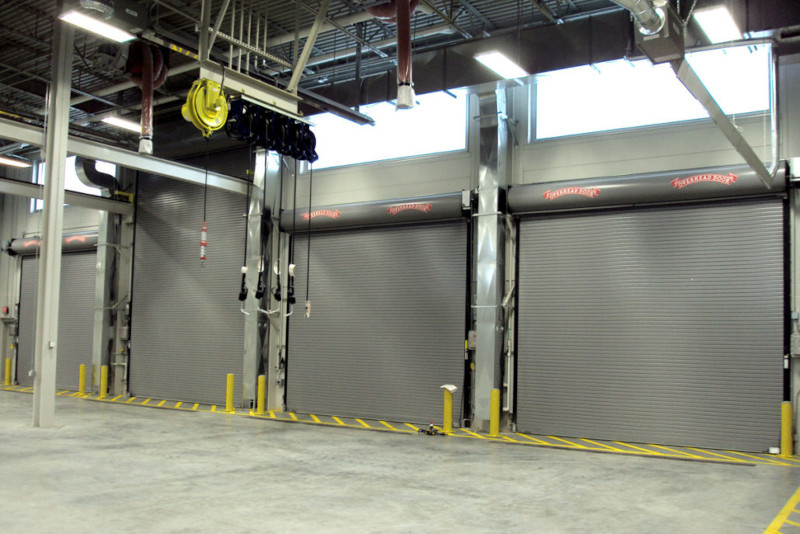
Commercial overhead doors improve security through heavy-gauge steel construction, reinforced locking systems, rolling code access technology, integrated alarm connections, tamper-resistant hardware, and compliance with DASMA and UL-verified load and impact ratings. Security failures at commercial facilities most often occur at access points, and the overhead door is the largest and most frequently used of those points, making its construction, locking system, and access control setup the first line of defense.
Overhead Door Company of Charleston installs and services commercial overhead doors for businesses throughout Charleston and nearby communities.
Why Commercial Overhead Doors Are a Security Priority
The overhead door is the most critical security point in any commercial facility because of what it protects and how large that exposure is when it fails. A standard entry door that is breached exposes a single room. A commercial overhead door that is compromised exposes the entire bay, loading area, or warehouse floor in one opening.
In warehouses and distribution centers, the overhead door is frequently the only access point wide enough to move inventory, equipment, and vehicles, making it the preferred target for organized theft. DASMA technical standards define structural requirements for commercial overhead doors precisely because the size and load of these openings require verified performance specifications rather than estimates.
Heavy-Gauge Steel Construction
The panel material and gauge of a commercial overhead door is the foundation of its physical security. Commercial overhead doors are built from heavier gauge steel than residential models, with panel thickness and core construction rated to resist forced entry attempts.
Commercial steel overhead door panels are commonly available in 24-gauge and 25-gauge steel, with 24-gauge being the thicker and more impact-resistant option. Heavier gauge panels resist denting and deformation from pry bars, bolt cutters, and impact tools at a level that lighter residential panels cannot match. Insulated panels with steel skins on both faces add structural rigidity beyond a single-skin panel because the foam or polystyrene core bonds the two steel faces into a composite that distributes impact load rather than concentrating it at the point of contact.
Reinforced Locking Mechanisms
The locking system determines whether the panel’s structural strength translates into actual security. Commercial overhead doors use slide bolt locks, multi-point locking bars, and keyed cylinder locks that secure the door at multiple points along the bottom rail and side tracks.
Technicians installing commercial door locks consistently find that single-point locking systems allow the door to be pried from the track at the corners even when the center lock holds. A rigid panel secured at one central point creates a lever, and enough force at either corner rotates the door around that lock and pulls it free of the track. Multi-point locking systems that engage at the door’s bottom corners and mid-sections eliminate this vulnerability by distributing resistance across the full width of the door. Heavy-duty steel slide bolts mounted independently of the operator add a secondary manual lock layer that remains engaged even when the operator is bypassed.
Automated Operators With Access Control Integration
Automated commercial door operators add a security layer that manual doors cannot provide: controlled, logged, and restricted access. Modern operators integrate with keypads, card readers, intercoms, and smartphone-based systems to limit who can open the door, when, and from where.
Modern commercial door operators use rolling code technology, generating a new encrypted signal with every use. An intercepted code from a previous transmission is mathematically invalid on the next cycle, making code-grabbing attacks ineffective. Access logs from integrated control systems give facility managers a timestamped record of every activation, who authorized it, and from which credential. Time-based access restrictions can limit operation to business hours only, so the door cannot be opened by any credential outside of defined windows.
Tamper-Resistant Hardware and Track Systems
The hardware connecting the door panel to its track system is where many security assessments stop short. Heavier tracks, stronger hinges, and reinforced brackets are standard in commercial installations, but specific hardware decisions during installation determine whether that hardware holds under attack.
One of the most overlooked vulnerabilities on commercial overhead doors is the bottom bracket, which connects the door to the lifting cables. When bottom brackets are secured with sheet metal screws, a forced entry attempt pushing the bottom of the door inward creates enough leverage to pull the bracket from the panel and defeat the entire track system. Heavy-duty bottom brackets rated for the full dead weight of the door, secured with carriage bolts through the panel rather than surface-mounted sheet metal screws, eliminate this vulnerability. Technicians who understand this failure mode install correctly from the first visit rather than discovering it on a return service call.
Wind Load and Impact Ratings
Wind load ratings are a security specification as much as a weather specification. A door engineered to resist the lateral pressure of high-speed wind has panel reinforcement and hardware connections that resist the same class of forces applied by physical attack.
DASMA publishes wind load performance data for commercial overhead doors under their technical data sheet program. Doors rated to higher wind load specifications have additional vertical stiffeners and reinforced end stiles that distribute applied force along the full panel height rather than concentrating it at the weakest point. For businesses in coastal areas like Charleston, wind-rated commercial overhead doors deliver storm protection and improved physical security from the same structural upgrade.
Integration With Alarm and Surveillance Systems
A commercial overhead door operating in isolation from the building’s security infrastructure provides only as much security as its physical hardware. Integrating it with alarm and surveillance systems creates a connected layer of detection, documentation, and response.
Door position sensors wired into the alarm panel trigger an alert when the door opens outside of authorized hours or remains open beyond a defined window. Vibration detectors on the panel surface can signal an impact event before an entry attempt succeeds, giving security personnel response time. Facilities that pair their operators with surveillance cameras at the door opening create a system where every activation generates a timestamped video record, giving staff both an alert and visual confirmation of who opened the door and what passed through it. These integrations are configured during installation and can be retrofitted to existing operator systems in most commercial facilities without a full hardware replacement.
Fire-Rated Commercial Overhead Doors
Fire-rated commercial overhead doors contribute to both fire safety compliance and facility security. Fire-rated door assemblies are tested to UL 10B and UL 10C standards. UL 10B covers standard fire tests of door assemblies, while UL 10C addresses positive pressure fire tests, the more demanding protocol because it simulates conditions where pressure differentials drive fire and smoke through gaps rather than relying on gravity alone.
Technicians performing fire door drop tests regularly find that doors in facilities with poor maintenance records fail to release properly. Worn fusible links, painted-over release mechanisms, and bent tracks from years of impact all prevent the door from completing its drop sequence. Overhead Door Company of Charleston performs fire door drop tests as part of their commercial service offerings, confirming that safety-critical doors function when they are actually needed.
Preventative Maintenance as a Security Practice
Routine professional maintenance is a security practice, not just a mechanical one. A commercial overhead door that is structurally sound when installed degrades over time in ways that create vulnerabilities the facility manager may not notice until they become a problem.
Worn springs reduce the door’s closing force, creating gaps along the bottom seal that a motivated intruder can exploit. Damaged tracks allow the door to be lifted manually from outside because roller-to-track contact becomes inconsistent. Failed locking hardware may no longer engage the strike fully, leaving the door technically locked but physically unsecured. Overhead Door Company of Charleston technicians have identified worn bottom seals, misaligned tracks, and compromised locking components during routine maintenance visits before those failures created security gaps the facility manager was unaware of. A commercial preventative maintenance program creates a documented inspection record that supports insurance requirements and demonstrates due diligence to underwriters who ask for maintenance histories on commercial access points.
Choosing the Right Commercial Overhead Door for Security
Selecting the right commercial overhead door for security involves more variables than panel color and size. Panel gauge, locking system configuration, operator access control integration, and wind load rating all contribute to the security profile of the finished installation.
A 24-gauge steel panel with a multi-point locking bar, a rolling code operator integrated with a card reader and alarm panel, and a DASMA-rated wind load specification delivers a fundamentally different security outcome than a 25-gauge single-skin panel with a center-mounted padlock hasp. Working with a provider who understands the full specification, from DASMA load ratings to UL-compliant fire door assemblies, ensures the door performs to the level the facility requires.
Schedule a Commercial Overhead Door Security Assessment With Overhead Door Company of Charleston
If your facility’s commercial overhead doors need a security review, Overhead Door Company of Charleston is ready to assist. Ranked among the top commercial dealers at the 2025 IDA national convention, our team installs, services, and tests commercial overhead doors across Charleston and nearby communities. From fire door drop testing to commercial preventative maintenance and access control integration, reach out to Overhead Door Company of Charleston today to schedule a professional security assessment for your facility.