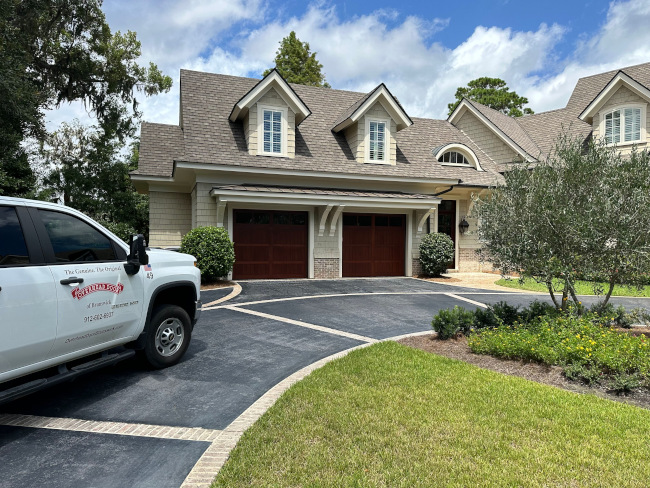
October is not the end of storm planning in Charleston. The Atlantic hurricane season runs through November 30. A useful fall garage door check therefore does two jobs: it finds wear from months of humid, salty weather, and it tells you whether the door can close and stay closed if the power goes out. You do not need to take apart a spring assembly to learn either answer.
We’re Overhead Door Company of Charleston, a garage door company based in North Charleston, South Carolina. This lowcountry fall garage door maintenance guide is organized by the decision each observation changes, not by a shopping list of products. A surface stain calls for a different response from a frayed cable or a door that no longer closes squarely.
Before You Start: Set the Safety Boundary
Do not use the garage door until a technician has inspected it if you see a broken spring, frayed or loose cable, displaced roller, crooked door, or a door that feels unusually heavy. Do not pull the emergency release, force the door, or try to adjust springs, cables, drums, brackets, or tracks. The Door & Access Systems Manufacturers Association (DASMA) warns that spring-system cables are under dangerous tension and should be replaced only by trained technicians.
For an otherwise normal door, inspect from the floor with the opening clear of people, pets, and vehicles. Keep hands away from hinges and other pinch points. Make observations and photographs before any cleaning or test. If anything looks damaged, skip the operating tests and request garage door service in Charleston.
The Five-Decision Fall Checklist
| What You Notice | What You Can Safely Do | Decision |
| Salt film or ordinary dirt on intact panels | Follow the model’s washing instructions | Clean and monitor the finish |
| A worn bottom seal or damp floor after rain | Photograph the water path; keep the area clear | Ask whether the seal, threshold, drainage, or flood setting needs attention |
| Frayed cable, broken spring, crooked or heavy door | Do not operate or touch the parts | Stop and schedule technician inspection |
| Opener reverses unexpectedly or sensors fail a test | Stop relying on automatic closing | Arrange service before storm travel |
| Unknown wind documentation or improvised bracing plan | Gather model and permit papers | Request a site-specific review; do not invent a wind rating |
1. Decide Whether the Exterior Needs Cleaning or Repair
Start outside with the door closed. Compare the bottom panel and exposed edges with the higher panels. Is the discoloration a removable film, a chip in the finish, bubbling paint, or actual rust? Photograph any change at the lower corners, section joints, hinges, handles, and fasteners.
A sheltered door on Johns Island may accumulate deposits differently from a wind-facing opening on Kiawah Island; use the condition you can see rather than a fixed neighborhood schedule.
For an intact finish, check your exact model’s care instructions before washing. An Overhead Door Traditional Steel homeowner manual calls for regular washing with mild detergent and clean water and cautions against harsh cleaners; its directions apply to that collection, not automatically to every wood, aluminum, or custom finish.
Work from the accessible exterior only. If a chip exposes metal, ask about a model-compatible touch-up rather than painting over an unknown coating.
Do not scrub a rusted spring or treat a corroded cable as a cosmetic issue. The earlier guide to coastal garage doors in Charleston covers product selection and wind documentation; this checklist is for deciding what to do with the door you already have.
2. Decide Where Water Is Entering
Look at the floor just inside the closed door after ordinary rain, not during a storm. Note whether the water is concentrated under the bottom seal, at one jamb, or along a wall. Check for daylight at the perimeter without putting a finger under the door. A brittle or torn seal can admit wind-driven rain, but water at a wall or slab edge may come from a different path. A new seal is not a flood barrier.
Charleston-area properties have different flood exposure. If the garage has engineered residential garage flood vents, do not cover or block them to keep the floor dry. Flood vents and weather seals solve different problems. Ask the installer or local building official what applies at your address rather than assuming a tighter door makes a flood-prone garage safe from water.
When the seal is visibly damaged, request an estimate that identifies the compatible seal and any threshold or door-alignment issue. If water tracks in from a different location, show the photos to a qualified building professional. Do not pay for a door replacement based only on a damp floor until the entry point is clear.
3. Decide Whether the Door Is Mechanically Sound
From a safe distance, look for gaps between spring coils, loose cable strands, a tilted bottom section, bent track, or a roller outside its track. These are not tune-up chores. Do not use the garage door until a technician has inspected it. DASMA’s safety guidance singles out springs and cables for professional attention because a failure can cause injury.
If the door is normal and undamaged, listen to one routine operating cycle from a safe position. A new scrape, sudden stop, change in speed, or shudder is a reason to stop testing and describe the symptom when booking service.
Avoid cycling the door repeatedly to see whether the noise disappears. If you have to leave by car, use another exit rather than forcing a damaged door.
The company offers a residential preventative maintenance program covering inspection of springs, cables, rollers, tracks, sensors, hinges, and opener parts. Ask what a visit includes for your door and whether it can address the exact finding you photographed. A professional balance check is more useful than a homeowner’s improvised lift test on a questionable door.
4. Decide Whether the Opener Is Ready for Normal Use
On a door with no visible damage, clear the doorway and follow the opener manufacturer’s instructions for its photo-eye and automatic-reversal tests. DASMA’s opener safety and maintenance guide explains that the photo-eye and contact-reversal functions are separate checks.
If either test fails, do not rely on the opener until it is serviced. Do not bypass sensors or increase closing force to push through a problem.
Check whether the wall control and remote work consistently. Replace remote batteries as directed by the manufacturer, then retest; persistent intermittent operation needs diagnosis. Opener wiring and logic-board repairs are not homeowner work because electrical faults and unsafe reversal settings can put people in the door’s path.
See the company’s garage door opener options if a technician finds replacement makes more sense than repair.
Before storm season ends, locate your model’s manual and ask a technician to demonstrate emergency operation on a sound, balanced door. Do not first learn the release procedure during a power outage, and never disconnect an opener from a damaged or heavy door. Ready.gov advises planning for outages as part of hurricane preparation.
A battery backup, where compatible, is worth discussing if garage access is important; it does not strengthen the door against wind.
5. Decide Whether Your Storm Plan Matches This Opening
A garage door is a large opening in the building envelope, but no universal “hurricane-proof” sticker replaces the documentation for the exact model, size, hardware, glazing, track, and installation. DASMA’s wind-pressure guidance explains why both inward and outward design pressures matter.
If you do not have the paperwork, ask for the installed model information and a qualified assessment before buying a brace or replacement.
Do not add homemade plywood or park a vehicle against the door to reinforce it. Ask how the installed assembly is meant to be secured before a forecast storm, and follow the manufacturer’s instructions.
The decision is different for a homeowner with complete installation documents and no damage than for someone whose door is already bent, rusty at load-bearing hardware, or missing labels. An inspection can identify repairs without implying every door needs replacement.
National hurricane guidance calls for an emergency plan and action before conditions become dangerous.
Finish routine door checks on a calm day. During a storm, do not operate the door or stand near it to see whether it is holding. Leave and shelter according to local instructions rather than making a last-minute door repair.
What Should You Book, and What Might It Cost?
A seasonal inspection is appropriate when the door functions normally but you want the springs, cables, hardware, balance, opener safety features, seals, and installation reviewed before more rain or storm activity. A repair appointment is more urgent for a failed safety test, damaged cable, crooked door, or heavy operation.
Tell the office what you observed; photographs and the opener model help the technician prepare.
There is no verified Charleston-specific flat price in the client materials for a fall inspection or repair, so we cannot honestly quote a dollar range as if it were this company’s rate. Ask for the current inspection fee or written estimate before authorizing work.
Cost changes with whether the job is inspection-only, replacement seals or rollers, spring or cable repair, opener service, or a wind-rated assembly review. Request a line-item explanation and do not agree to replacement merely because the door needs a seasonal check.
A maintained, functional door may need only cleaning, tests, and an inspection, not a new door. If the quote recommends replacement, ask which defect cannot be repaired economically and what wind documentation the proposed system includes. That question gives you a way to compare repair and maintenance service with a larger purchase on the same facts.
Frequently Asked Questions
When Should I Do Fall Garage Door Maintenance in the Lowcountry?
Choose a calm, dry day early enough to arrange service before a storm forecast. October is still within the Atlantic hurricane season, which runs through November 30.[1] Follow the manufacturer’s maintenance intervals as well as what you observe; there is no one date that fits every exposure and usage pattern.
Can I Wash Salt Off My Garage Door Myself?
Usually you can wash accessible exterior panels if the finish is intact and you follow the instructions for your exact model. A Traditional Steel manual, for example, calls for mild detergent and clean water. Do not pressure-wash damaged electrical components or scrub tensioned hardware.
Is a Rusty Spring Just a Cosmetic Problem?
Do not assume so. A spring is a loaded part of the lifting system, and visible deterioration calls for professional assessment. Do not use the garage door until a technician has inspected it if the spring is broken, the cable is frayed, or the door is heavy or crooked.[2]
How Do I Know Whether the Bottom Seal Is Causing a Leak?
Note where water appears after ordinary rain and photograph the seal and floor. A worn seal can be one cause, but water at a side wall or slab may need a different fix. A seal does not replace required flood provisions or make a garage floodproof.
Should I Disconnect My Opener Before a Storm?
Not by default. Learn the manufacturer’s emergency procedure in advance on a sound door and ask for a professional demonstration if you are uncertain. Do not pull the release on a door that is damaged, heavy, or crooked; that can let it move unpredictably.
What If the Photo-Eye or Reversal Test Fails?
Stop using automatic closing and schedule service. Follow your opener manual for a single safe test on an otherwise sound door, but do not defeat a sensor or adjust force to hide the failure.
How Much Does a Fall Garage Door Inspection Cost in Charleston?
The company has not supplied a verified public inspection price for this article. Request the current fee and scope before booking, then ask for a written estimate if a repair is recommended. Price depends on the actual fault and parts, not simply the season.
Make the Next Call Specific
If your door passes the safe checks, keep the photos and model details for the next maintenance visit. If you find damage or a failed safety feature, stop operating it and contact Overhead Door Company of Charleston for Charleston and nearby Lowcountry service at (843) 767-0028. Explain what you observed and ask for the current inspection scope and price before approving any work.